top of page
Laura CasellesTATTOOS · COLOUR · MADRIDInformation & prices ↗

Healed tattoos · Watercolour and colour

Healed watercolour tattoos: colour through the years.

"I love watercolour, but will it fade away?" I'd rather answer by showing you my tattoos years later. Here's Alice at eight years, a tiger at two, and a Stitch I shared at four. Let's look at the drawing, the colour and the details of each one. Because yes, a brand-new tattoo is lovely; I want you to see what comes afterwards too 💜

What you're looking at
Different pieces of mine, brought together in a healed tattoo carousel.
Documented ages
Alice: eight years; tiger: two; Stitch: four, when I shared these photos.
Touch-ups
Alice and the tiger: no touch-ups. For Stitch, I stated the age, not whether it had been touched up.
A different question
These photos don't show the healing stages of a fresh tattoo.

ONCE HEALED

Beyond day one.

When I show you a healed piece, we're no longer looking only at the moment it was finished. In this selection, you can look at the drawing and colour on the skin.

THROUGH THE YEARS

Examples with age and context.

Eight years for Alice, two for the tiger and four for Stitch: those are the ages I gave when sharing the photos you're about to see.

In this story01 · Alice: eight years, not a single touch-up02 · The tiger: colour and drawing after two years03 · Stitch: four years, photographed outside the studio04 · More subjects, the same question05 · Watercolour isn't just adding a few splashes06 · What I can show you, without promising a picture that never changes
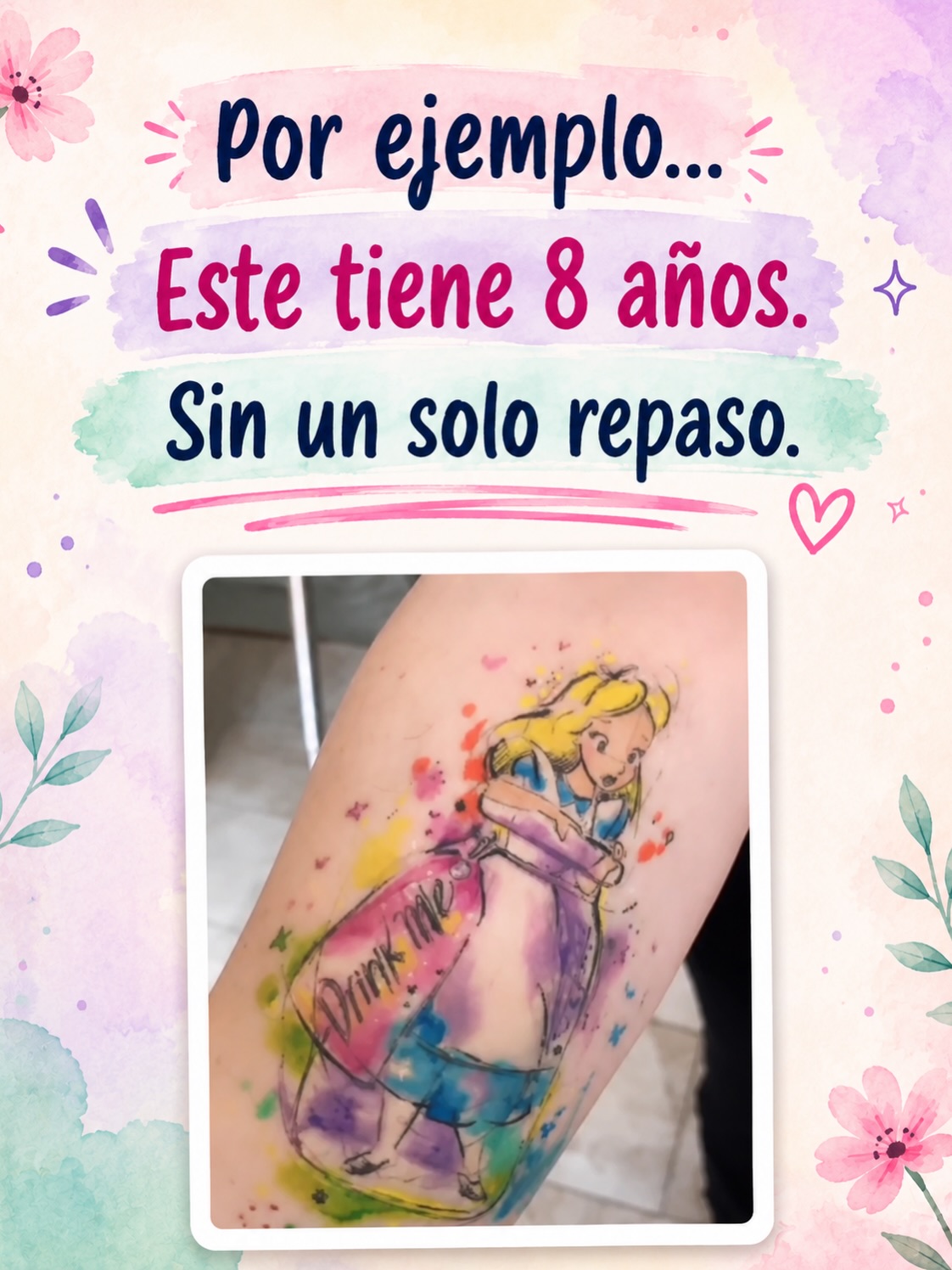
Alice inside a bottle with watercolour splashes; Laura presents the tattoo as eight years old without a touch-up
Alice in a bottle: shared at eight years, with no touch-ups.

01 / LOOKING OVER TIME

Alice: eight years, not a single touch-up

When I shared this photograph, the Alice tattoo was eight years old and hadn't had a single touch-up. That's the context I want you to have when looking at the image: this isn't a freshly finished piece.

Alice peers out from inside the bottle, with her yellow hair and blue dress. Around her are pinks, purples, greens and little details of colour. Notice that you can recognise the character and the bottle, but also distinguish the washes spilling beyond their edges. The watercolour and drawing still belong to the same composition.

If you're worried about the character becoming lost among the splashes, look closely at this image. You can study her face, dress and the rim of the bottle. It's a concrete way to answer that question with a piece of mine that was already eight years old.
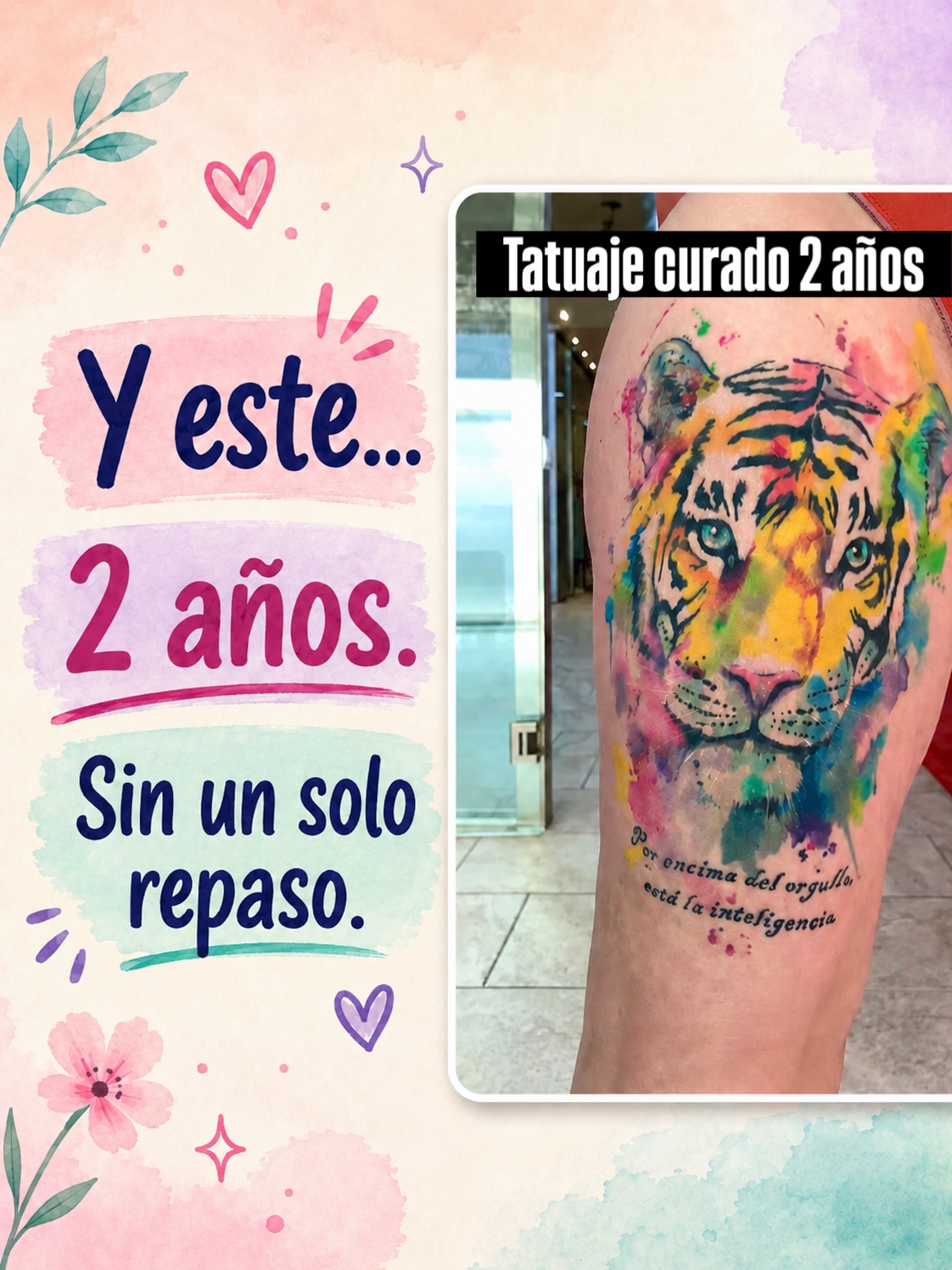
A front-facing tiger with yellow, pink, green and blue watercolour, presented by Laura as healed for two years without a touch-up
The tiger, two years old with no touch-ups in the image I shared.

02 / LOOKING OVER TIME

The tiger: colour and drawing after two years

This tiger was two years old and hadn't been touched up when I shared it either. The subject changes completely here: from a character to an animal's gaze, with dark stripes and a mix of yellows, pinks, greens and blues.

Don't just look at how much colour there is. Look at the eyes, nose and stripes, and how the head stays recognisable within the washes. Here the colour goes beyond the outline, but the drawing doesn't disappear into it.

I show it alongside Alice because they're two different ways of working with watercolour. The question doesn't have to stop at "does the blue last?": you can also look at whether the composition reads clearly and which parts hold the drawing together as a whole.
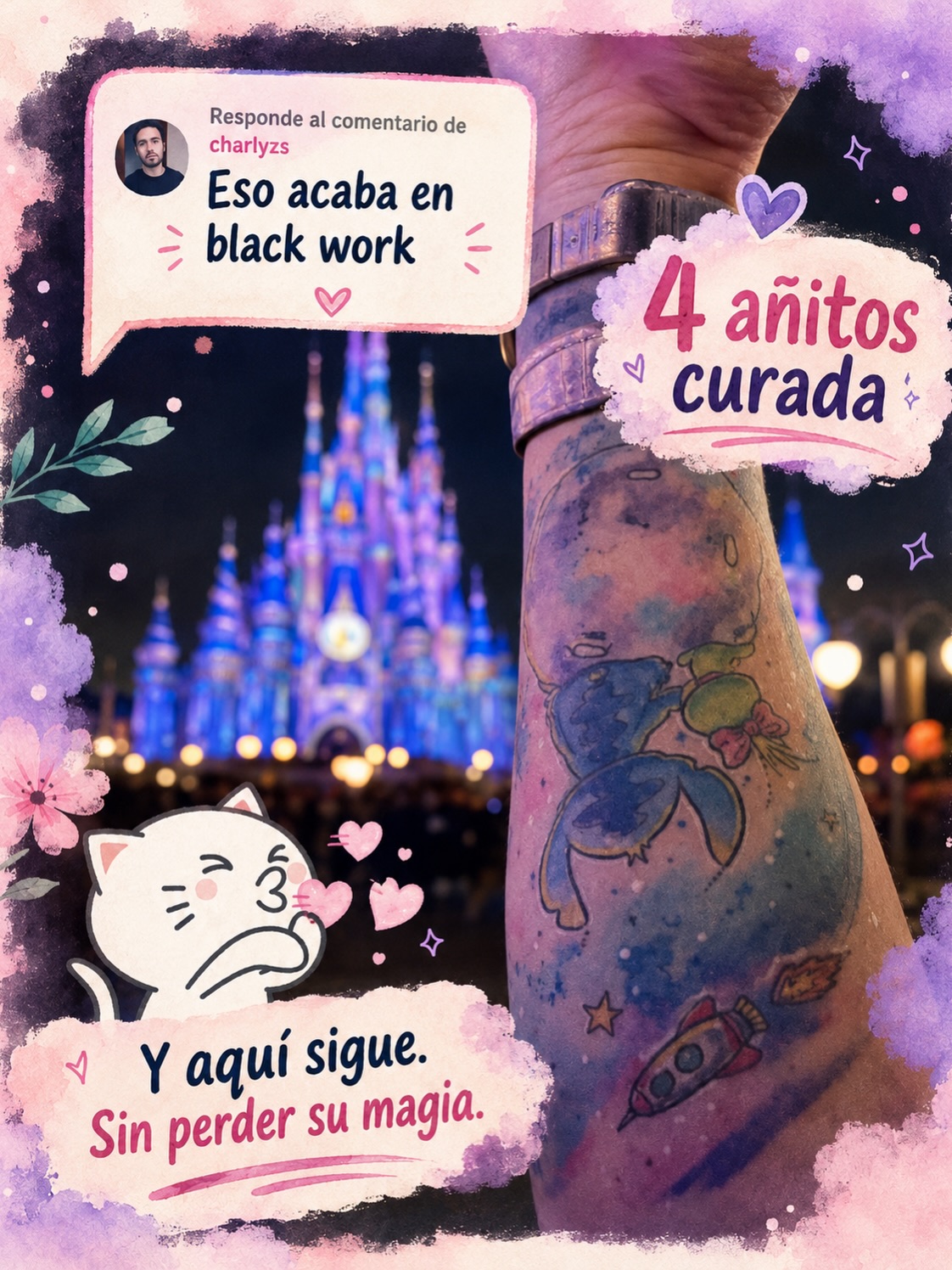
A watercolour Stitch tattoo on a forearm in front of an illuminated castle; the post describes it as healed and four years old
Stitch, photographed outside the studio and shared four years healed.

03 / LOOKING OVER TIME

Stitch: four years, photographed outside the studio

I shared this Stitch four years healed. The photo was taken in front of an illuminated castle: the setting and lighting differ from the other images, and that's part of how you're seeing it.

You can still recognise the figures, planet and rocket, along with the watercolour washes running along the forearm. It's a view of the tattoo at another moment, not a way to precisely compare colour intensity against a photo taken in different light.

Look at the whole piece too: how the motifs are arranged along the forearm and how the colour accompanies them. The castle is part of the photo, but Stitch's little universe is on the skin.
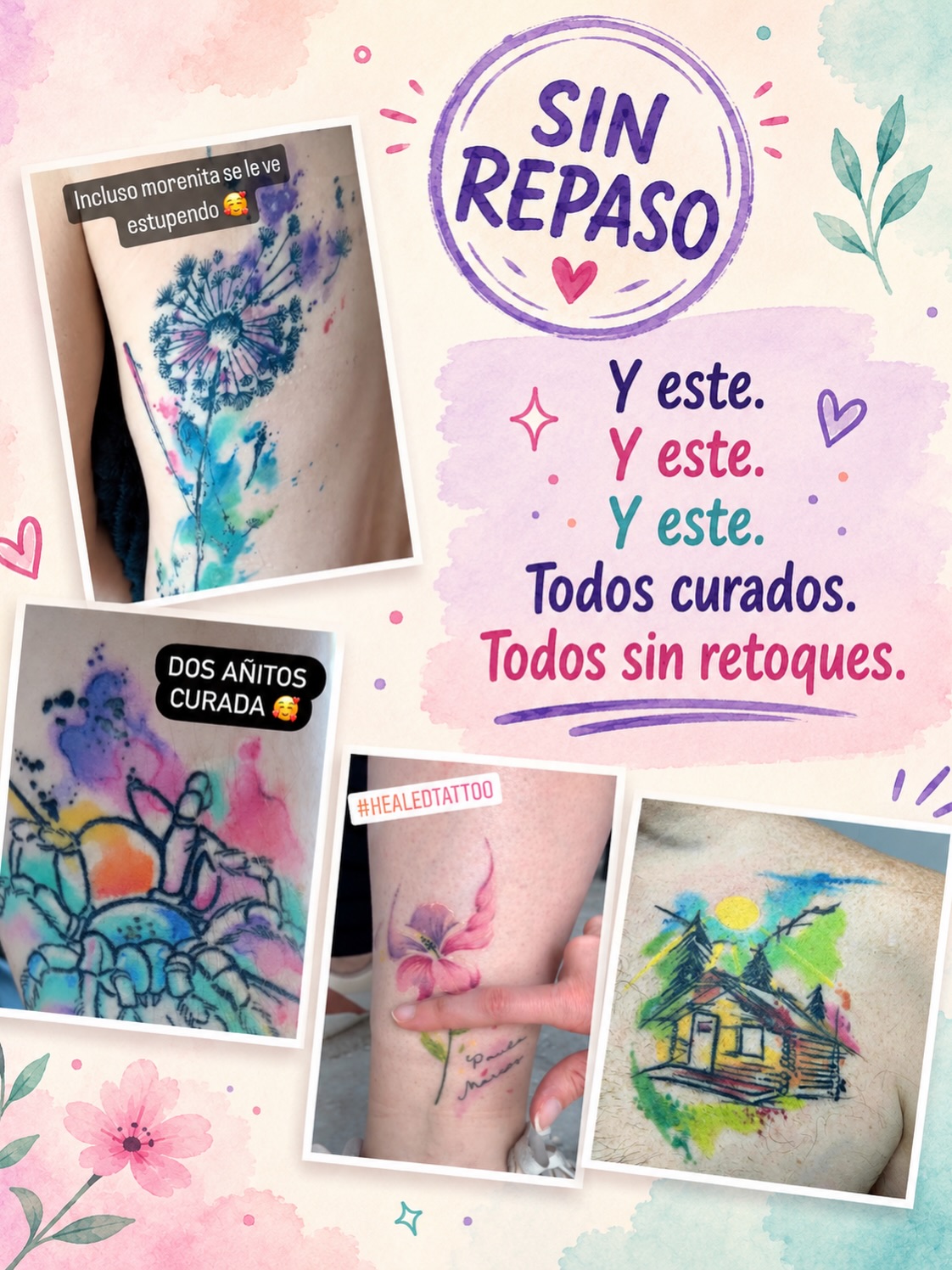
Four tattoos Laura describes as healed without touch-ups: dandelion, crab, pink flower and cabin
Four pieces I shared healed and without touch-ups: dandelion, crab, flower and cabin.

04 / LOOKING OVER TIME

More subjects, the same question

The carousel also brought together a dandelion, a crab, a pink flower and a cabin among trees. I described them as healed pieces without touch-ups. I gave the crab's age as two years; that image doesn't specify an age for the other three.

Look at how colour plays a different role in each. The dandelion has spreading lines and surrounding washes. You can make out the crab's claws and body among pinks, blues and yellows. The flower uses softer shapes; the cabin keeps its lines among trees and areas of colour.

They're four different tattoos, not four stages of one piece. They let me show you variety: whether you're interested in flowers, animals or something more illustrative, you can look at an example closer to the idea you have in mind.

05 / LOOKING OVER TIME

Watercolour isn't just adding a few splashes

In that carousel, I explained how I work: I don't create the watercolour effect simply by diluting inks. I build it with colour, contrast, translucent layers and spaces of skin. It's not an ink that comes with the effect built in; what matters is how intense areas, transitions and spaces relate to the drawing.

That's why I've been pointing out different details: Alice and her bottle, the tiger's gaze and stripes, the figures in Stitch's universe. I don't just want you to look at a pretty splash, but at how the whole piece reads.

If you're choosing someone to trust with your idea, ask to see their healed work too. Ask how old the tattoos were when photographed and whether they've been touched up. To me, that's a much more useful conversation than deciding only from day-one photos.

06 / LOOKING OVER TIME

What I can show you, without promising a picture that never changes

These examples let me show you my tattoos still recognisable years later, with the context I published for each. That's my response to the idea that all watercolour inevitably disappears or needs constant touch-ups.

Each image shows a particular piece, with its own lighting, framing and the age I stated when sharing it. I can talk about those examples and how I work; I can't promise another tattoo will age in exactly the same way.

When you ask about your idea, tell me what worries you: losing details, colours becoming unclear or the composition changing over time. Then we can discuss that concern with specific examples, instead of stopping at "watercolour: yes or no?".

A CLOSER LOOK AT THIS TATTOO

Questions about watercolour and healed tattoos

Do watercolour tattoos disappear over the years?

I wouldn't say they disappear just because they're called watercolour. Here I show my work at two, four and eight years, with recognisable drawing and colour. These are real examples of my work, not a guarantee that all tattoos will age the same way.

Do they need constant touch-ups?

In the carousel, I presented Alice at eight years and the tiger at two, both without touch-ups; I also shared four other pieces without retouching. That shows constant touch-ups weren't inevitable in these examples. It doesn't mean no tattoo could ever need one.

Does this show how a watercolour tattoo heals?

This mainly shows several pieces once healed and after some time. It's not a diary of the first few days or a guide to assessing a skin reaction. For fresh tattoo guidance, I keep the aftercare section separate.

What should I look at besides the colours?

Look at whether you recognise the subject, how its parts stay distinct and how the colour works with the drawing. With Alice, look at the character and bottle; with the tiger, the eyes and stripes. Always ask when the photo was taken and whether there were any touch-ups.

How do you create the watercolour effect?

I build it through colour, contrast, translucent layers and spaces of skin. It's not simply a matter of diluting ink: I work on how intense areas, transitions and spaces relate to the drawing. In the carousel, I explain that approach alongside the healed examples.

Are these before-and-after photos of the same tattoo?

No. I brought different pieces together to show various subjects and ages. Each photo has its own context; I don't present them as stages of change in one tattoo.

How old were the tattoos in these photos?

When I shared these photos, I stated eight years for Alice, two for the tiger and four for Stitch. I added that Alice and the tiger hadn't had touch-ups; for Stitch, I gave the age without that extra detail.

Can I see the whole post?

Yes, I've linked the original carousel so you can go through it in order. It included a paid collaboration with Bepanthol Tattoo; here, I've focused on my tattoos and the context of the photographs.

These examples come from my healed watercolour tattoo carousel. The original post includes a paid collaboration with Bepanthol Tattoo. Original post ↗

Ageing isn't only about style: the American Academy of Dermatology notes that ultraviolet radiation can fade some tattoo inks. Dermatology source ↗

On dilution, manufacturers such as StarBrite describe professional uses for shading and opacity. The FDA warns about contamination risks from non-sterile water; it does not state that all dilution is poor technique. Manufacturer's context ↗ · FDA information ↗

If you've just been tattooed, you can find my guidance in the aftercare section. Read aftercare guidance ↗

A DIFFERENT QUESTION?

Another starting point. Another example.

YOUR IDEA, YOUR STARTING POINT

Your idea can begin with colour, too.

Tell me which subjects appeal to you, where you picture them and what size you have in mind. If you like an example, explain whether it's the colours, the drawing or the way it sits on the body.

Ask about my watercolour tattoo ↗
bottom of page